The Core Problem: Why Robots Fail in the Real World
A robot trained on simulation alone encounters its first dented aluminium can and treats it as an unknown object. It meets a gripper worn differently from the pristine simulated one and hesitates. These are not model failures. They are data failures.
Simulation offers perfect labels and infinite volume. Real-world footage is smaller, noisier, and harder to annotate. But simulation misses the edge cases that will break your robot in production: dented surfaces, worn tools, collision states it was never designed to see. The sim-to-real gap closes through one mechanism: expert annotation of real-world failures, fed back into retraining. The quality of those labels determines whether your model actually learns from the gap or memorises the mistakes.
Understanding the Simulation Data Advantage
Simulation offers what real-world data cannot: infinite volume, perfect labels, and systematic coverage.
Synthetic data strengths:
- Volume without cost. Generate millions of gripper positions, object rotations, and background variations in hours.
- Perfect ground truth. Every label is mathematically exact (no human subjectivity).
- Systematic variation. You control precisely which conditions to include: lighting levels, object materials, collision scenarios.
- Reproducibility. Train a second model on identical synthetic data and get identical results.
Where synthetic fails:
- Blindspots are systematic, not random. Simulation misses failure modes it wasn't designed to capture. A simulated warehouse has perfect shelving; real shelving has dents, rust, missing labels.
- Physics is never perfect. Simulated gripper friction doesn't match real gripper friction. Simulated cloth drapes differently than real cloth.
- Rare events are absent. That moment when a box shifts unexpectedly mid-grasp? Rare in the real world, nonexistent in simulation.
This is why pure simulation fails. A model achieves 95% accuracy on synthetic test data but 60% in production. The 35% gap isn't randomness. It's the distribution shift—the systematic difference between what simulation covers and what reality contains.
Real-World Data: Messiness as Ground Truth
Real-world data is smaller, harder to collect, and imperfect. It is also the only mirror of actual deployment conditions.
Real-world data strengths:
- Ground truth for deployment. This is what your gripper will actually encounter.
- Edge cases are real. The dented can, the worn gripper, the unexpected collision—these matter because they happen.
- Failure modes are visible. When a robot fails in production, the recorded video reveals why (if annotated correctly).
- Rare events are captured. Collect enough real-world footage and you will see the 1-in-1,000 edge case that breaks your model.
Real-world data weaknesses:
- Smaller volume. Collecting, processing, and annotating real-world video is expensive. You get fewer images per pound spent.
- Labelling is harder. Ambiguity exists. That gripper state—is it fully closed or partially flexed? A human annotator must decide.
- Data imbalance. Real-world gripper-open events outnumber gripper-closed events by 10-to-1. Training on imbalanced data invites poor performance on the rarer class.
The Data-Quality Lever: Why Annotation Closes the Sim-to-Real Gap Faster
The mechanism is straightforward: humans identify edge cases simulation missed, label them with expert precision, and feed the labels back into retraining. The quality of those labels determines whether the model actually learns from failure or inherits it.
Three-stage workflow:
Stage 1: Synthetic foundation. Train a baseline model on simulation. Core mechanics learned: gripper control, spatial reasoning, object recognition. Accuracy: 90%+ on synthetic test data.
Stage 2: Real-world failure collection. Deploy the model in controlled trials. Record every failure—hesitation, wrong prediction, grasp failure. This becomes your edge-case dataset.
Stage 3: Expert annotation and retraining. Domain expert (roboticist, gripper specialist) annotates each failure. Gripper state, object material, collision point, lighting condition—whatever caused the break. Feed annotated failures back to training. The model now encodes: "When worn metal is encountered, apply 10% more grip force." Production accuracy jumps.
The difference between success and failure at each stage is label quality. Poor annotation (generic tags, no expertise, missing ambiguous cases) means the model memorises noise and sees no pattern. Expert annotation means each failure becomes a retraining signal, and the sim-to-real gap closes measurably with each cycle.
Why Commodity Vendors Struggle with This
Commodity annotation vendors (those optimised for speed and low cost) excel at simple, high-volume tasks: labelling 2D images, basic bounding boxes, text categorisation. They struggle with robotics annotation because it requires:
- Domain expertise. Gripper states are learned knowledge. An annotator who's never held a gripper doesn't know what "partially closed" looks like, or why it matters.
- Temporal reasoning. Gripper state changes over a sequence of frames. One frame doesn't reveal intent. The sequence does. Commodity annotators label frame-by-frame without understanding temporal context.
- Closed-loop feedback. When a model fails, the annotation team needs to understand why it failed (model brittleness, mislabelled training data, or a genuine edge case?). Commodity vendors treat annotation as a batch task, not a feedback loop.
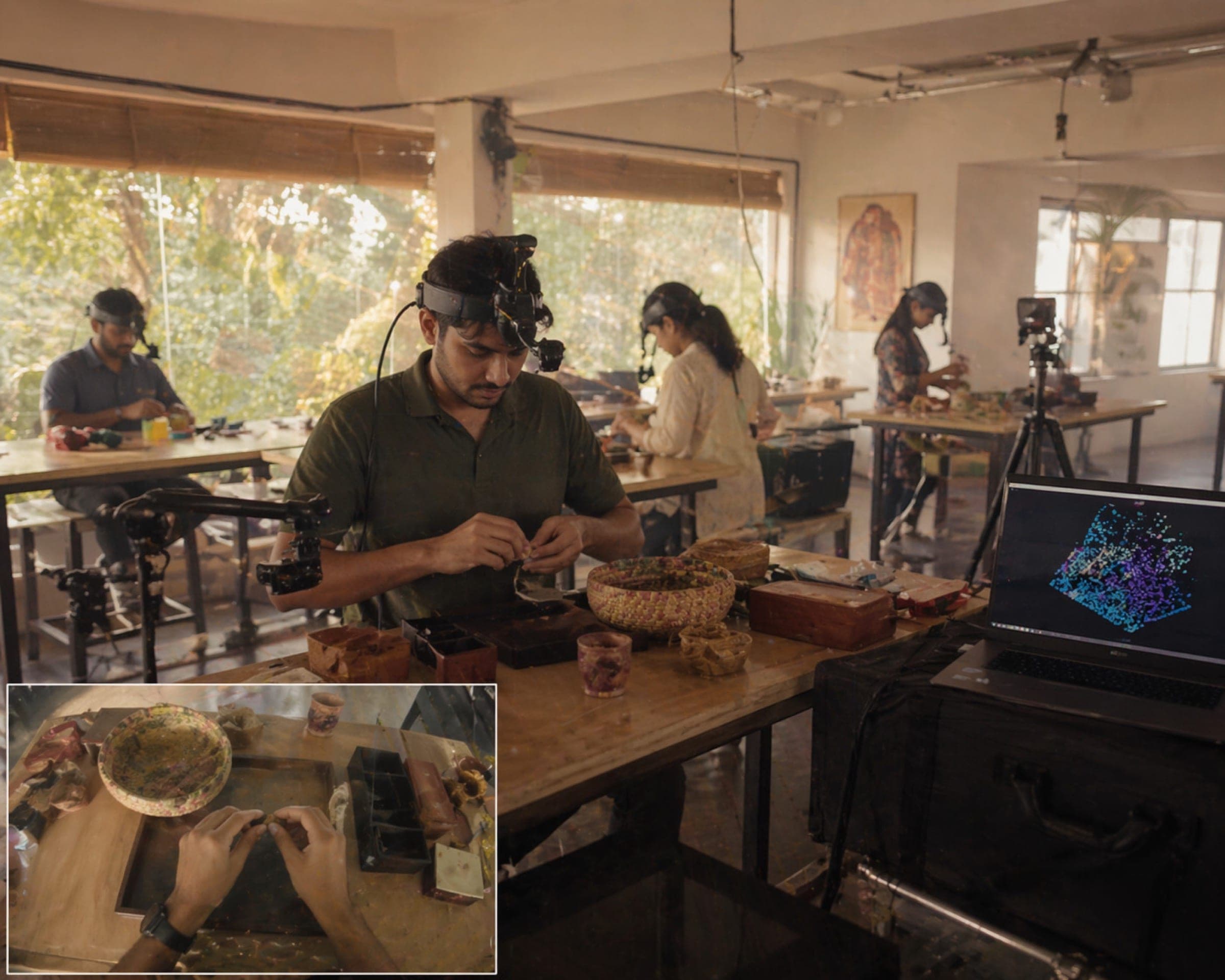
IndiVillage's robotics annotation team has labelled egocentric video for CeCe and RIA (Machani Robotics' companion robots) for 18+ months. This is not a commodity service. The team understands gripper mechanics, teleoperation nuance, and failure modes specific to embodied AI. When they annotate real-world failures, they annotate with context—flagging which errors are truly novel and which are labelling inconsistencies.
Hybrid Approaches: Balancing Simulation and Reality
The optimal strategy for most robotics teams is not "all simulation" or "all real-world." It's a hybrid:
Foundation phase (simulation-heavy):
- Use high-volume synthetic data to train core model (gripper control, spatial reasoning).
- Aim for 90%+ accuracy on synthetic test set.
Refinement phase (real-world addition):
- Collect real-world video from controlled trials (not production yet).
- Annotate failures and ambiguous cases (not every frame—only informative examples).
- Retrain on synthetic + real-world mixture. This is where sim-to-real gap shrinks.
Production phase (real-world validation):
- Continuous collection of production-environment footage.
- Sampling and annotation of edge cases (biased toward failures and low-confidence model predictions).
- Quarterly retraining cycles incorporating new edge cases.
This hybrid approach requires annotation discipline: you must sample and label strategically (failures first, then ambiguous cases, then representative success cases), not randomly. IndiVillage's QA protocols flag model errors automatically (using confidence thresholds), prioritise those for annotation, and feed results back to retrain-on-a-schedule.
When to Commit Fully to Real-World Data
Simulation remains the foundation, but three signals indicate it's time to increase real-world data investment:
Signal 1: Prototype phase is complete. You have a working baseline model. Synthetic data got you here. Now you need production robustness.
Signal 2: Deployment timelines are pressing. You have 6 months to deploy. Synthetic-only strategies take 12+ months to mature. Real-world annotation accelerates learning.
Signal 3: Safety-critical deployment. Warehouse automation, surgical robotics, autonomous vehicles—these demand edge-case coverage. Simulation alone won't provide it. Real-world annotation identifies and covers the cases simulation missed.
At this stage, the investment shifts: from "free synthetic data" to "expensive real-world annotation." But the ROI is measured in production success rate, not per-image cost. A 2% improvement in production accuracy (from 93% to 95%) on a 10,000-unit deployment is worth six months of real-world annotation.
Common Mistakes in Balancing Simulation and Real-World Data
Mistake 1: Treating simulation as unlimited. "We'll just generate more synthetic data." This fails because the distribution gap remains—more of the same synthetic data doesn't fill the blindspots.
Mistake 2: Assuming real-world data is self-annotating. "We'll collect video and the model will figure it out." Poor. Unannotated video teaches nothing. Annotation is the work.
Mistake 3: Underestimating edge-case annotation cost. "Real-world failures are obvious; anyone can label them." Incorrect. Gripper failures require domain expertise to interpret. Cheap annotation misses the nuance that matters.
Mistake 4: Losing track of taxonomy drift. After 1,000 real-world frames, annotators develop habits: shortcuts in gripper-state labelling, inconsistent handling of ambiguous cases. Taxonomy drifts. Quality degrades invisibly until production fails. Prevent this with gold-set validation (compare every 50th annotation to a reference standard) and inter-rater agreement checks.
Vendor Requirements: Making Sim-to-Real Work at Scale
If you're outsourcing real-world annotation for sim-to-real refinement, demand:
- Domain expertise in robotics. The vendor has annotated egocentric video, gripper states, and temporal sequences before.
- Closed-loop feedback capability. They can integrate with your model-training pipeline (not batch-processing in isolation).
- Gold-set methodology. They maintain reference annotations for quality benchmarking as volume scales.
- Drift detection. Regular inter-rater agreement checks. When agreement dips below threshold, they pause and recalibrate.
- Edge-case triage. They sample intelligently: failures first, ambiguous cases second, representative successes third (not random sampling of all footage).
IndiVillage's approach to Machani Robotics' egocentric video annotation includes all of these. CeCe and RIA's training data is annotated with closed-loop feedback—model failures trigger re-annotation priorities, taxonomy updates, and retraining schedules. The result: 18 months of zero-drift QA on an increasingly complex real-world deployment.
The Stakes: When Sim-to-Real Alignment Matters
The gap between simulation and reality is not academic. It is operational cost.
A gripper fails to grasp a dented can. One production stoppage. Manual intervention. Schedule delay. A robot misidentifies a collision state. Wasted motion. Wasted energy. Or worse—a safety incident. A model trained purely on simulation breaks in production. Retraining cycle. Delayed deployment. Customer confidence lost.
Each of these is prevented by one mechanism: accurate annotation of real-world failures, fed into retraining. The label quality determines whether the robot learns robustness or merely memorises noise. This is why sim-to-real annotation is the work that determines whether your production deployment actually works.
Frequently Asked Questions
Q: Can I skip simulation and go straight to real-world annotation? A: Technically yes, but inefficiently. Simulation trains the core mechanics cheaply. Real-world annotation is expensive and should be reserved for edge cases and refinement, not foundation-building. Start with simulation; add real-world data when deployment timelines demand it or safety margins require edge-case coverage.
Q: How much real-world data do I need to close the sim-to-real gap? A: Depends on your domain and deployment environment. For gripper-control tasks with moderate environmental variation, 10,000-50,000 real-world frames of diverse scenarios usually suffices. The key is stratification—failures over-represented, successes under-represented, and edge cases explicitly captured. A poorly-selected 1M frames teaches less than a well-stratified 50K frames.
Q: What happens if my real-world annotation is poor quality? A: The model learns the wrong lessons. It memorises labelling errors instead of learning real-world patterns. Retraining becomes counterproductive—accuracy drops because the model is now trained on corrupted labels. This is why annotation quality matters more than volume for real-world data.
Q: Who should annotate real-world robotics footage? A: Someone with domain expertise. For gripper-control tasks, an engineer or roboticist who understands gripper mechanics. For vision-based tasks, a computer-vision specialist or domain expert (agricultural for crop robots, medical for surgical robots). Commodity annotators are not equipped for this.
Q: Can I use crowd-sourced annotation for real-world robotics data? A: Not reliably. Gripper states, collision points, and edge cases require expertise to identify correctly. Crowd workers will make errors systematically (e.g., mislabel subtle gripper states). Use crowd work only for simple, high-consensus tasks (bounding boxes, obvious labels). Reserve domain experts for the nuanced work that determines production success.
Q: How do I know if my sim-to-real gap is closing? A: Track production accuracy over time. If your model accuracy is improving as real-world data accumulates, the gap is closing. If accuracy plateaus despite more real-world data, your annotation quality is the bottleneck (not volume), and you need either more expert review or taxonomy refinement.
Q: Should I retrain on simulation + real-world mixed, or real-world only? A: Mixed. Simulation teaches foundations; real-world adds robustness. A model trained on simulation + real-world consistently outperforms one trained on real-world alone, because simulation provides systematic coverage of common cases (allowing the model to focus learning on edge cases). The mixture amplifies each dataset's strength.
JSON-LD Schema
{
  "@context": "https://schema.org",
  "@type": "FAQPage",
  "mainEntity": [
    {
      "@type": "Question",
      "name": "Can I skip simulation and go straight to real-world annotation?",
      "acceptedAnswer": {
        "@type": "Answer",
        "text": "Technically yes, but inefficiently. Simulation trains the core mechanics cheaply. Real-world annotation is expensive and should be reserved for edge cases and refinement, not foundation-building. Start with simulation; add real-world data when deployment timelines demand it or safety margins require edge-case coverage."
      }
    },
    {
      "@type": "Question",
      "name": "How much real-world data do I need to close the sim-to-real gap?",
      "acceptedAnswer": {
        "@type": "Answer",
        "text": "Depends on your domain and deployment environment. For gripper-control tasks with moderate environmental variation, 10,000-50,000 real-world frames of diverse scenarios usually suffices. The key is stratification—failures over-represented, successes under-represented, and edge cases explicitly captured. A poorly-selected 1M frames teaches less than a well-stratified 50K frames."
      }
    },
    {
      "@type": "Question",
      "name": "What happens if my real-world annotation is poor quality?",
      "acceptedAnswer": {
        "@type": "Answer",
        "text": "The model learns the wrong lessons. It memorises labelling errors instead of learning real-world patterns. Retraining becomes counterproductive—accuracy drops because the model is now trained on corrupted labels. This is why annotation quality matters more than volume for real-world data."
      }
    },
    {
      "@type": "Question",
      "name": "Who should annotate real-world robotics footage?",
      "acceptedAnswer": {
        "@type": "Answer",
        "text": "Someone with domain expertise. For gripper-control tasks, an engineer or roboticist who understands gripper mechanics. For vision-based tasks, a computer-vision specialist or domain expert. Commodity annotators are not equipped for this level of nuance."
      }
    },
    {
      "@type": "Question",
      "name": "Can I use crowd-sourced annotation for real-world robotics data?",
      "acceptedAnswer": {
        "@type": "Answer",
        "text": "Not reliably. Gripper states, collision points, and edge cases require expertise to identify correctly. Crowd workers will make errors systematically. Use crowd work only for simple, high-consensus tasks. Reserve domain experts for the nuanced work that determines production success."
      }
    },
    {
      "@type": "Question",
      "name": "How do I know if my sim-to-real gap is closing?",
      "acceptedAnswer": {
        "@type": "Answer",
        "text": "Track production accuracy over time. If your model accuracy is improving as real-world data accumulates, the gap is closing. If accuracy plateaus despite more real-world data, your annotation quality is the bottleneck, and you need either more expert review or taxonomy refinement."
      }
    },
    {
      "@type": "Question",
      "name": "Should I retrain on simulation + real-world mixed, or real-world only?",
      "acceptedAnswer": {
        "@type": "Answer",
        "text": "Mixed. Simulation teaches foundations; real-world adds robustness. A model trained on simulation + real-world consistently outperforms one trained on real-world alone, because simulation provides systematic coverage of common cases, allowing the model to focus learning on edge cases."
      }
    }
  ]
}
{
  "@context": "https://schema.org",
  "@type": "Article",
  "headline": "Simulation vs. Real-World Training Data for Robots: Which Matters More?",
  "description": "Why robots trained purely on simulation fail in production, and how real-world annotation closes the sim-to-real gap.",
  "author": {
    "@type": "Organization",
    "@name": "IndiVillage",
    "logo": {
      "@type": "ImageObject",
      "url": "https://indivillage.co.uk/logo.png"
    }
  },
  "datePublished": "2026-05-26",
  "image": {
    "@type": "ImageObject",
    "url": "https://indivillage.co.uk/images/robotics-sim-vs-real.png",
    "width": 1200,
    "height": 630
  }
}