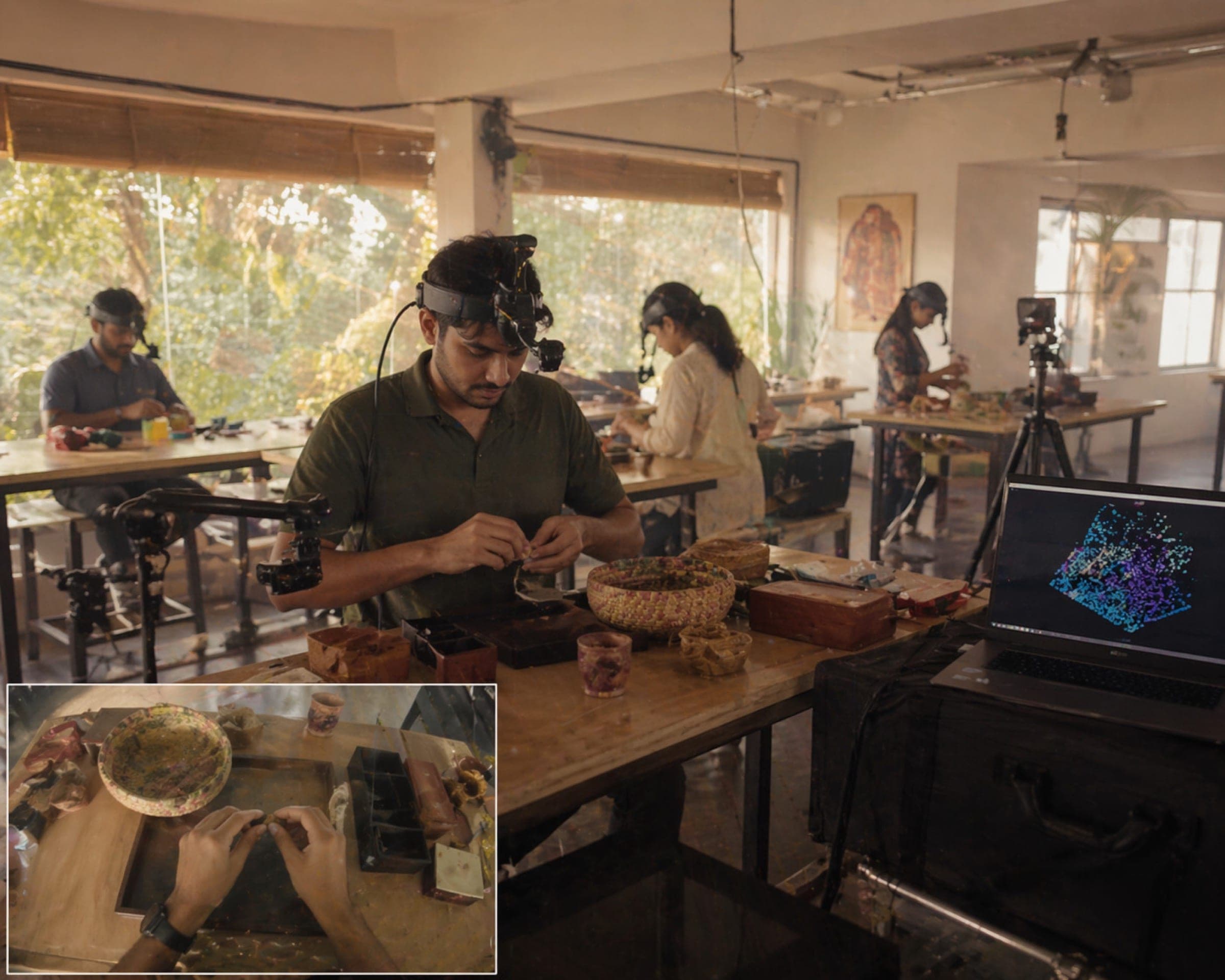
raining a language model and training a robot are fundamentally different. Text data is cheap and abundant; robot video is expensive and domain-specific. LLM data pipelines optimise for scale and coverage; physical AI pipelines optimise for precision and iteration. Confusing the two will lead to cost overruns and delayed models.
The core differences
Text data is static; robot data is dynamic. A sentence doesn't change between experiments. A robot video recorded today might become obsolete if you upgrade the camera or the gripper. You can't reuse old data without recapturing or re-annotation.
Text labels are binary; robot labels are continuous. You either spelled a word correctly or you didn't. A robot's gripper closing is a continuous process — exactly when did the grasp start? How much force? These ambiguities require rubric discipline and specialist judgement.
Text scales horizontally; robot scales vertically. You can collect 10x more text data by hiring more labellers. You can't collect 10x more robot video without 10x more robots, 10x more environments, or 10x more time.
Text iteration is additive; robot iteration is destructive. If you improve a language model's prompt, all downstream applications benefit. If you change a robot's annotation schema midway through training, you must re-annotate and retrain — there's no way to merge old and new labels.
Data acquisition: the forgotten bottleneck
Before annotation even starts, physical AI pipelines face acquisition challenges. You need:
- Diverse environments: A robot trained only in lab conditions fails in the field. You need data from 5–10 distinct locations, lighting conditions, and object distributions.
- Failure cases: Datasets that only show successes train models that fail at edge cases. Explicitly capture and label robot failures — missed grasps, collisions, recoveries.
- Sensor diversity: If your production robot uses RealSense, but your simulator uses Gazebo, the sim-to-real gap is huge. Collect real-world data from day one.
This is why robotics companies often spend 40–60% of annotation budget on acquisition, not labelling. You're not just paying annotators; you're running robots, hiring operators, managing environments.
Annotation workflows for physical AI
Iteration loop: In NLP, you label once, train once, ship. In robotics, you label a batch, train, test on real robots, identify failure modes, update your rubric, re-label, retrain. This cycle repeats 3–5 times before deployment.
Annotation coverage: NLP annotation is uniform — every sentence gets the same treatment. Robotics annotation is stratified. You over-annotate failure cases (1:5 ratio of failures to successes) and under-annotate obvious successes.
Feedback loop speed: With 1000 sentence examples, an LLM team can iterate in days. With 1000 robot video frames, you might iterate in weeks because you're waiting for data acquisition, annotation, retraining, and live validation.
QA and validation specifics
Traditional AI QA: Inter-annotator agreement (Cohen's kappa, F1 scores). If two annotators agree 90%+ of the time, the labels are good.
Physical AI QA: Agreement is necessary but not sufficient. You need:
- Simulation validation: Do annotated labels work in simulation? Train a model on annotated data, test in Gazebo, measure success rate. If sim success is <80%, the annotations are probably wrong.
- Live validation: Deploy the trained model on real robots in controlled tasks. Measure real-world success. Sim-to-real gap is your biggest signal of annotation quality.
- Residual analysis: Which tasks or objects fail most? Trace failures back to annotation. Was the schema ambiguous? Did annotators miss a key feature?
These validation loops are expensive but essential. Skip them and you'll deploy models that fail silently on edge cases.
Cost and timeline reality
Robotics annotation projects require longer timelines and more specialist resources than NLP projects due to data acquisition, iteration, and validation complexity. You're not just labelling — you're engineering a data pipeline that actually produces working models. The cost of annotation is outweighed by the cost of data acquisition and continuous model refinement.
Iteration costs and why multi-quarter programs win
If you budget for one round of annotation and one round of training, you'll hit the sim-to-real gap and be forced to re-annotate. This is expensive and demoralising.
If you budget for 3–4 rounds of annotation + training + validation from the start, you build in the iteration cycles naturally. You're not surprised when models fail; you expected it and budgeted for it.
Multi-quarter programmes also let you keep annotation teams stable. Turnover is expensive in physical AI — a new annotator is unproductive for 4–6 weeks. Stable teams drive down cost and improve quality.
What this means for you
Physical AI data pipelines are not "data annotation at scale." They're integration projects that combine robotics operations, data science, and annotation engineering. If you're building a model for a real robot, you can't think of data as a commodity.
The difference between a robotics team that ships and one that stalls often comes down to annotation expertise. A specialist who understands your domain catches edge cases that generalists miss. This is why stable, experienced annotation teams compound knowledge in ways that commodity labour cannot.
Budget for acquisition, annotation, QA, iteration, and contingency — in that order of importance. Plan for 6–12 months minimum. Hire annotation specialists, not gig workers. Treat annotation as part of your machine learning workflow, not a separate vendor relationship.
Learn more about multi-quarter annotation programmes or explore robotics data strategies.