Case Study · Healthcare
98%
AI accuracy on real-world RDT interpretation in diverse field settings.
Audere · multi-geography deployment · HIPAA-aligned
02 · The challenge
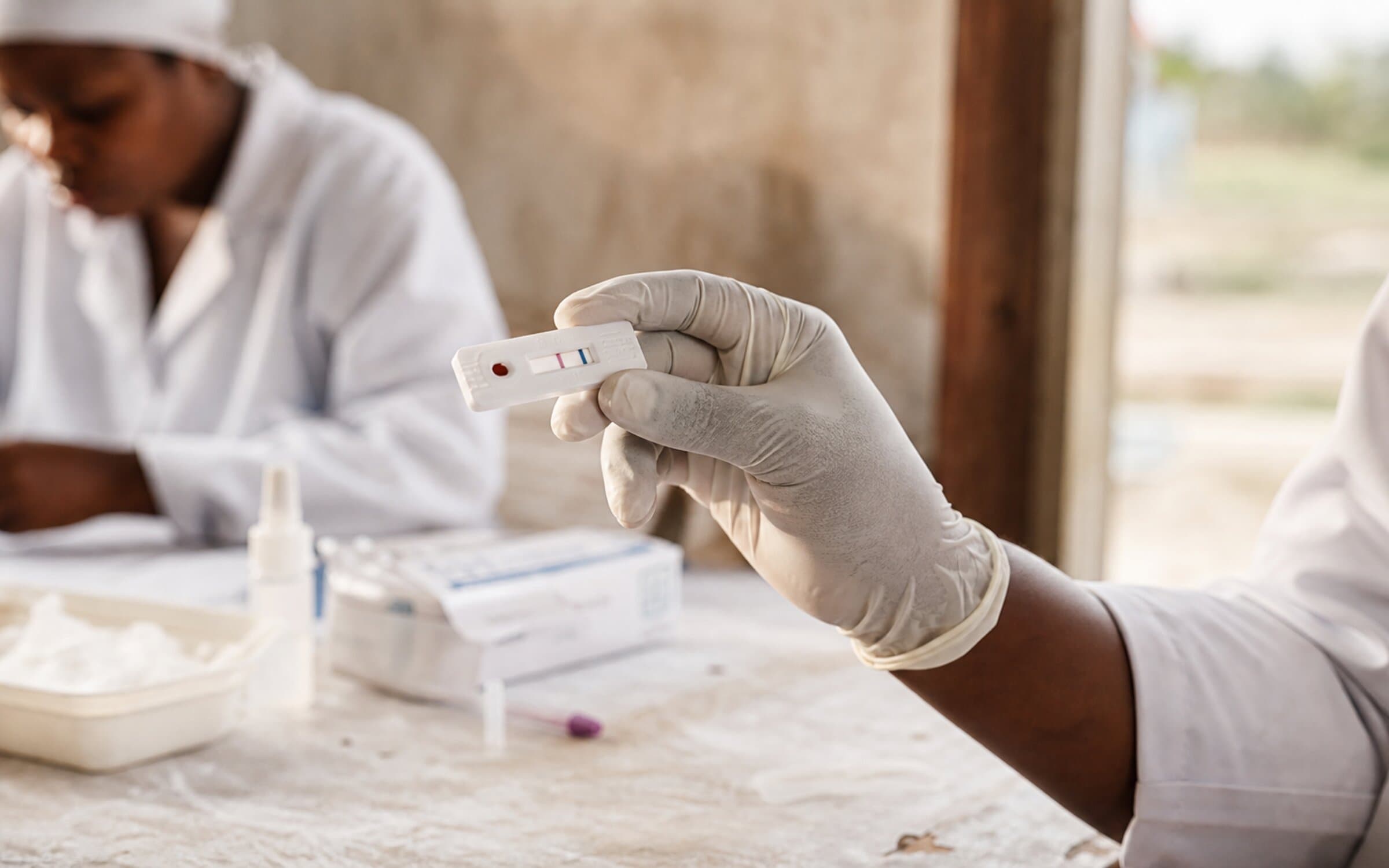
Rapid diagnostic test images arrive blurry, glare-soaked, or poorly lit. Inconsistent cassette formats and faint test lines defeat automated detection. Scale demanded precision from day one.
RDT cassettes from field clinics span brands, lighting, and image quality. Many contain personally identifiable information. Before any AI could train, these images needed structural classification, PII redaction, and expert review of ambiguous cases.
Previous automation attempts failed because they bypassed the human interpretation layer. Clinical diagnostics cannot tolerate approximation. The dataset itself was the bottleneck.
03 · How we did it
Human-in-the-loop annotation scaled across diagnostic formats.
01
Visual classification
Each RDT cassette was assessed for test outcome and metadata extraction. Brand, patient identifier, batch ID, and image quality were tagged. This structural tagging became the foundation for downstream AI training.
631,000+ images classified
02
PII redaction
Patient identifiers were securely removed from every image before annotation. HIPAA-aligned workflows ensured sensitive data never reached the training pipeline. Compliance built into process, not bolted on after.
HIPAA-aligned workflow
03
Expert review
Ambiguous or unclear cases were escalated to medical professionals. Dual-review loops caught edge cases. Clinical judgment informed the tagging protocol. Continuous refinement tightened classification rules based on error patterns.
185,000+ annotations QA’d
04
Dataset curation
Low-quality and problematic images were filtered out entirely, not stored for later. The training dataset was smaller but coherent. Consistency across 631,000 interpretations held because the team stayed the same.
96% staff retention · 16 years
04 · The outcome
The dataset’s consistency enabled rapid model convergence. Because the same annotators worked across years, quality standards compounded. Knowledge accumulated. Edge cases improved, not reset. The team’s continuity became a procurement-grade advantage.
Audere’s AI became a trusted decision-support tool across underserved regions with limited clinical infrastructure. Diagnosis and care acceleration followed. Scale without accuracy would have been dangerous. Accuracy at scale solved the real problem.
05 · In their words
“By providing accurately labelled images of the most widely used diagnostic tool globally, they have provided an invaluable input into our computer vision algorithms, allowing us to build highly accurate AI that assesses the quality of administration and interpretation of RDTs.”

Paul Isabelli · Chief Operating Officer · Audere
06 · The numbers underneath
631K+
RDT images
classified
185K+
High-quality
annotations
07 · Other programmes that shipped
Same operating discipline. Different modalities.
08 · Work with us
Run a diagnostic dataset audit.
100 samples. Your modality. Your accuracy target. Returns in 48 hours — with a clinical-grade fit assessment.
Run a healthcare audit
08 · Work with us
Run an annotation audit on your data.
Send us 100 frames in any modality — image, video, LiDAR, audio, text. We'll return annotated output, an accuracy benchmark, and a programme recommendation in 48 hours.

 Taranis